What breaks when you move RDS for MySQL to 9.7?
Four changes stop apps that run on 8.4, and 8.0 databases have paid for Extended Support since August 1. The rate doubles in August 2028.
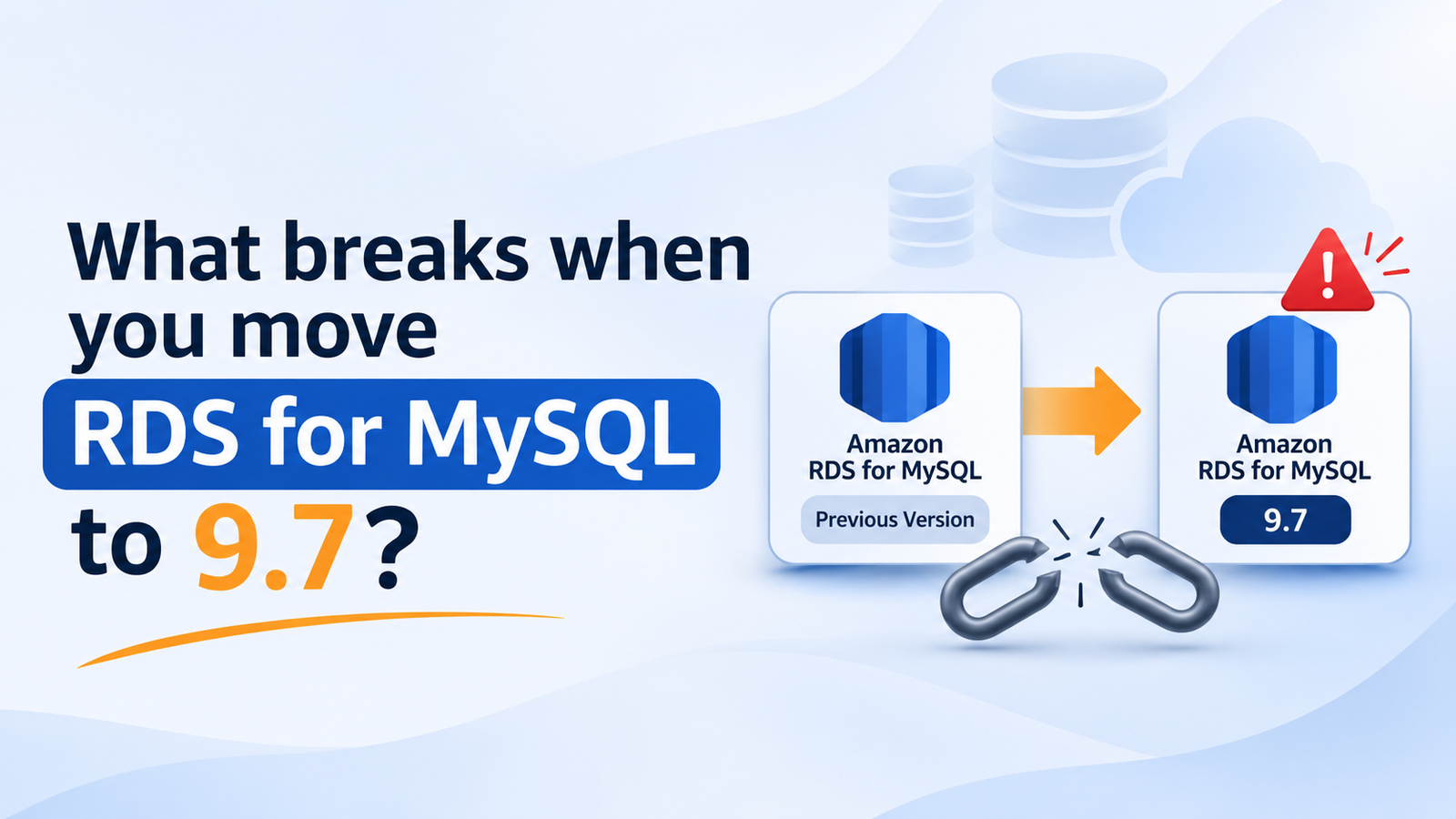
Amazon RDS for MySQL 9.7 went generally available on November 18, 2026. It removes mysql_native_password and MD5(), requires TLS by default and blocks some Multi-AZ clusters. MySQL 8.0 has been in paid Extended Support since August 1, 2026, at $0.10 per vCPU-hour in US East (Ohio), doubling on August 1, 2028.
What breaks when you upgrade from MySQL 8.4 to 9.7?
Four things stop an application that works on 8.4. The mysql_native_password plugin is gone, so any account still using it cannot connect after the upgrade, and AWS gives a query against mysql.user to find them. The MD5() and SHA1() SQL functions are not available on RDS for MySQL 9.7, and AWS points to SHA2() instead. EXTERNAL and LIBRARY are now reserved words, so any table or column with those names must be quoted or renamed. Multi-AZ DB clusters with two readable standbys are not supported at launch, and upgrades from them are blocked. DevelopersIO tested 9.7.4 on RDS and hit the same errors for the plugin, both functions and both reserved words.
Which MySQL 9.7 defaults can break a working setup?
Four defaults can break a setup that works on 8.4 today. The require_secure_transport setting is now ON, so clients that connect without TLS are rejected. A bare EXPLAIN returns TREE output instead of the tabular format, which can break tools that parse it. The validate_password settings are renamed to dot notation, such as validate_password.length, and values in your 8.4 parameter group are not applied, so password validation can fall back to defaults weaker than your policy. The gtid_mode setting moves to ON_PERMISSIVE, so an external replica running gtid_mode=OFF is no longer a supported target and must be raised to at least OFF_PERMISSIVE first. Record your 8.4 parameter group values before you start.
How much does staying on MySQL 8.0 cost on RDS?
MySQL 8.0 left RDS standard support on July 31, 2026, and Extended Support charges began on August 1. AWS prices it per vCPU per hour: $0.10 for the first two years and $0.20 from year three, which starts August 1, 2028. Those are the rates for US East (Ohio), and the price depends on the Region. A Multi-AZ instance with one standby bills both instances, so an 8 vCPU database costs $1,168 a month at the first rate, using 730 hours a month, and $2,336 from August 2028. Extended Support for 8.0 ends July 31, 2029, the same day standard support for 8.4 ends. Our story on Windows Server 2016 extended support costs covers another bill of this kind.
What is the upgrade path to MySQL 9.7?
MySQL upgrades to the next long-term support series only, so the path is 8.4 to 9.7. A database on 8.0 goes to 8.4 first, and one on 5.7 goes 5.7 to 8.0, then 8.4, then 9.7, with a blue/green deployment for each hop. AWS recommends Blue/Green Deployments over read replicas or an in-place upgrade, and they work from a database already in Extended Support. Extended Support for 5.7 now runs to June 30, 2029, up from February 28, 2027, at the same price. RDS launched 9.7 at minor version 9.7.4, with standard support to July 31, 2031.
What should IT teams do about RDS for MySQL 9.7 today?
- Run
SELECT user, host FROM mysql.user WHERE plugin = 'mysql_native_password';on every 8.4 instance and move those accounts to caching_sha2_password. - Search application code and stored programs for MD5() and SHA1(), and plan replacements with SHA2().
- Check schemas for tables or columns named external or library.
- Confirm clients connect over TLS, or set require_secure_transport to OFF on purpose in the parameter group.
- Write down your validate_password values and set the matching dot-notation parameters in the 9.7 group.
- Keep Multi-AZ DB clusters on 8.4 until AWS supports them on 9.7. Our checklist for PostgreSQL 19 upgrades covers the other big open-source database that shipped this week.
- Count vCPUs on every 8.0 database, including standbys, price them at your Region's rate, and schedule the 8.0 to 8.4 hop now to stop the charge.